

As we started descending to the crater through Lemale mini gate we were told by the personnel manning the entrance that we should get to the other side of the ‘basin’ before 18:00 hours just to meet the authority’s regulations that no one will be allowed to be inside the crater come the sated time.
We noticed how rich the crater was in terms of varieties of wild animals. Records indicate Ngorongoro Crater has more than 25,000 animal’s population. Just name it; you would find one.
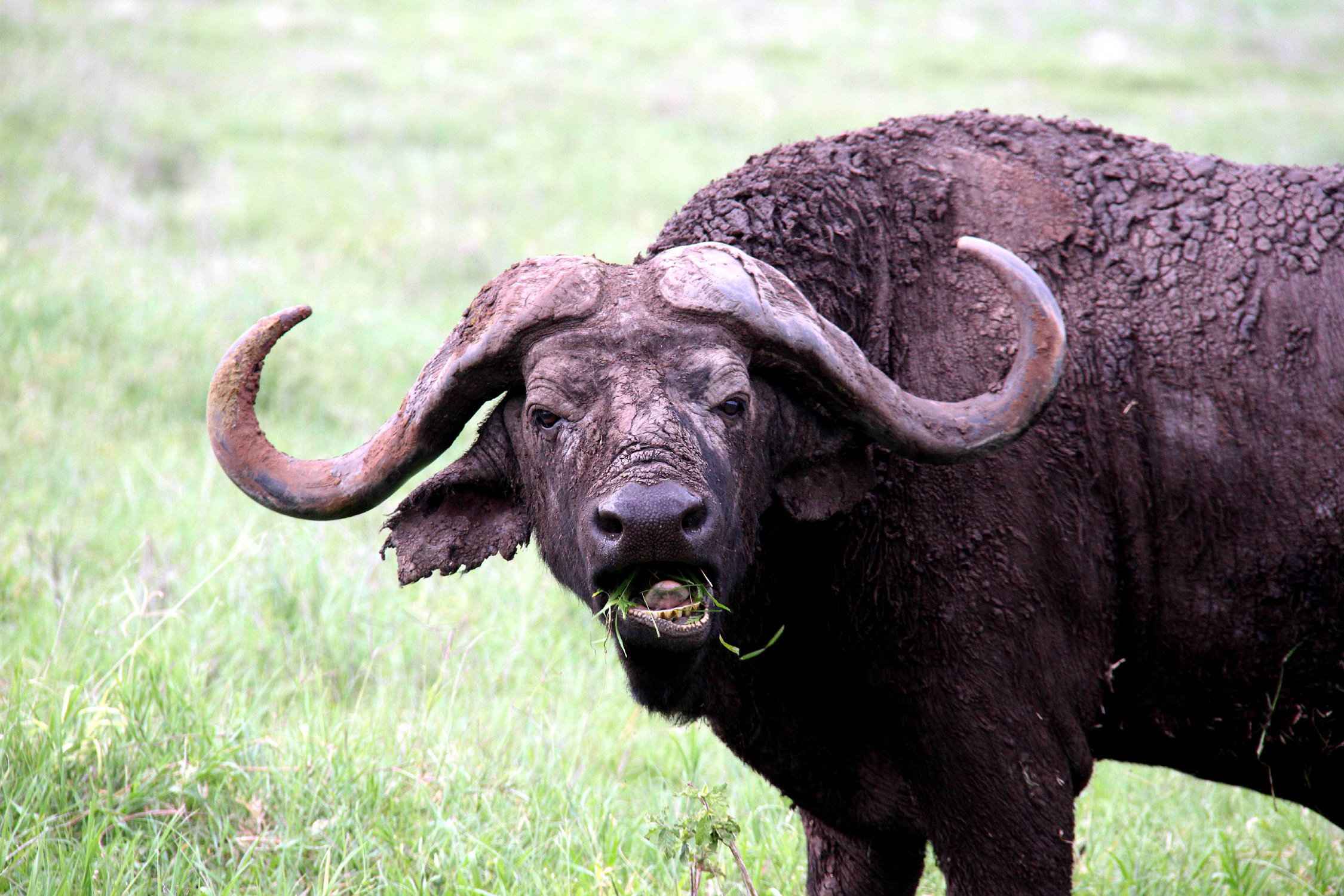
At one point we came face to face with a herd of Cape Buffalos grazing just on the side of the road we were passing. What an amazing opportunity to come an eye ball to eye ball with the beasts! Remember, these are one of the ill-tempered and craziest creatures in Africa which some nicknamed them as “black death” because of their aggressiveness, and can kill when provoked.
Some of them were covered with mud and, if you cared to look carefully, you might have thought someone had purposely ‘painted’ these creatures with the same – while it wasn’t the case.

The act, according to professionals, is referred as “mud wallowing”. It is said that wallowing serves as a cooling method where an animal reduces or regulates its body temperature. Conversely, when the mud dries it stands as protection against sunburn while also providing much-needed relief from stinging or biting insects that would usually be lurking around.
The animals which are part of Africa “big five” can easily be spotted inside the crater plus the remaining four which include Lion, African Elephant, Leopard and Black Rhinoceros.
As our trip was to Naiyobi Ward and back to Waso in Loliondo both in Ngorongoro District – Arusha on the same day we had to travel quite some distance, manoeuvring through the volcanic mountains along the Ngorongoro Crater, to reach the destined ward.

On our way to Naiyobi we came across two craters, one being Empakai, not very much prominent to many but admittedly yet another place worth paying a visit. This particular crater looks like a bowl with plenty of water in it. On reaching the crater instincts will force you to stop and wonder at God’s creation.
While at Naiyobi, you will have a good view of the famous Ol Doinyo Lengai Mountain, the only mountain in Tanzania with an active volcano known for its frequent though minor eruptions. The mountain, whose name is Maasai translating into ‘Mountain of God’, stands at 2,960 metres above sea level.

Thanks to Ngorongoro Conservation Area Authority (NCAA) for its tireless efforts in maintaining the area’s natural habitat. It’s no wonder that NCAA has long been declared – and is internationally recognised as – one of the World Heritage Sites in Tanzania. The other sites are Stone Town of Zanzibar, Serengeti National Park, Selous Game Reserve, Kilimanjaro National Park, the Kilwa Kisiwani and Songo Mnara Ruins, and the Kondoa Rock-Art Sites.
These are some of the tourist attraction sites Tanzania is blessed with and are readily available and reachable for Tanzanian and international tourists to marvel at, cherish and explore.
WanderTZ/Emmanuel Kwitema

